FUNDACIÓN ONUART


FREQUENTLY ASKED QUESTIONS
When was Fundación ONUART established?
On 24 April 2007, in a ceremony presided over by the Minister of Foreign Affairs and Cooperation Miguel Ángel Moratinos, the Fundación ONUART was constituted in Madrid (ONU is the Spanish abbreviation for the United Nations). It is a private, non-profit-making agency with mixed public-private funding whose aims are to use Spanish contemporary art to promote dialogue and drive understanding between cultures and societies and its potential to stimulate multilateralism in Geneva. Presided over by the Spanish Minister of Foreign Affairs and Cooperation, Miguel Ángel Moratinos, the Fundación integrates public and private bodies that share the same goal of promoting multilateralism and its principles and values, to contribute to the dialogue and promotion of human security. The Foundation’s structure includes a Consultative Council which integrates the members of the Board of Trustees and the Heads of all Geneva-based multilateral agencies, and that is tasked with reviewing and providing recommendations for future collaborations with multilateral institutions.

What is Fundación ONUART’s mission?
Fundación ONUART has been given a wide-ranging mandate and will provide a platform to underline the potential for art as a catalyst for dialogue and driver of understanding between cultures and societies, and multilateralism in Geneva. It will stimulate high-level debate to inspire tolerance and goodwill among all people in all international organisations - that art should a more transcendental ambition for the 21st century.

Why is Geneva considered a centre for multilateralism?
Geneva is the capital of European multilateralism, with the United Nations’ Palais des Nations at its centre. Two thirds of multilateral activity in the world takes place in this city, the setting for some 8000 conferences a year for about 25,000 delegates from all over the world, many of these under the supervision of the United Nations Office at Geneva (UNOG). As well as being the UN European headquarters (UNOG), Geneva plays host to some 200 international organisations working in the social, health, economic, scientific, technological, humanitarian, human rights and security disciplines. Approximately 9,000 people are employed by the UN system in Geneva, 3,800 of them directly by UNOG. More than 120,000 tourists visit the Palais des Nations each year.

What does the project consist of?
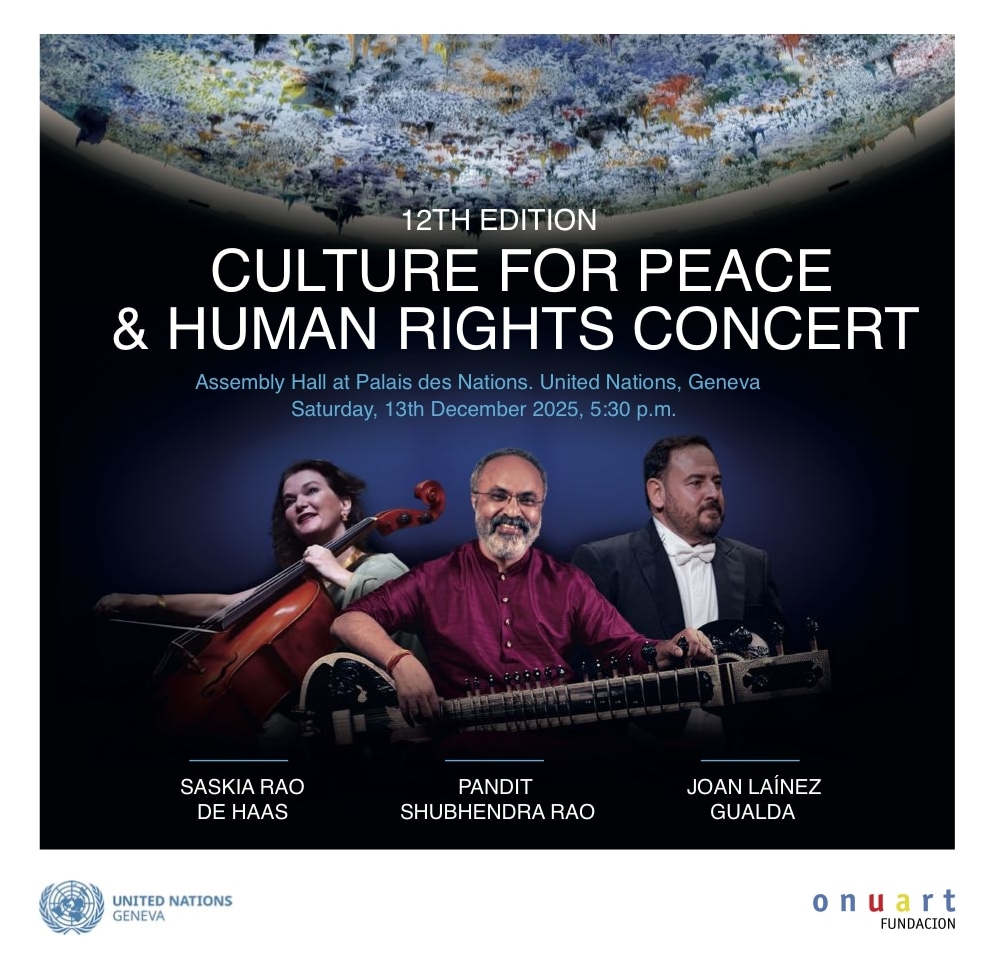
The project consists of the complete renewal of Room XX at the United Nations Palais des Nations including refurbishment and re-equipment. This new meeting venue will have the official title of “Chamber of Human Rights and for the Alliance of Civilisations” and will host the Human Rights Council. It will be one of the largest and most important of all the negotiating rooms of the UN, and will have the most state-of-the-art facilities. The room’s enormous ellipsoidal dome presents the backdrop for the room’s center piece – a painting by Miquel Barceló. This painting will be the most important artistic contribution to the UN since its creation in 1945.
It will be equipped with the latest Spanish technology and design and feature a modular structure to give numerous configuration options. This re-equipment will include technology for audiovisual resources, conference services, interpretation systems, information technology and telecommunications. The project is expected to set the standard for all future refurbishments of UN buildings.

What level of resources will Miquel Barceló be using?
He’s using one hundred tonnes of paint with pigments from all corners of the globe, specially designed equipment, with the involvement of specialists in various disciplines, including particle physics laboratories, engineers, architects and others in heritage restoration. Miquel Barceló has gathered a truly exceptional support team to overcome unprecedented technical and artistic challenges for the completion of this ambitious project.

What is Miquel Barceló’s background?
Miquel Barceló was born in Majorca and has become an influential figure on the Spanish art scene ever since he took part in Kassel’s Documenta VII in 1982. After moving to Barcelona he gained acclaim for the great diversity of his work, from enormous canvasses, used as opera backdrops, murals and engravings to ceramic sculptures and, in his most recent work, a terracotta skin for Saint Peter’s Chapel in the Palma de Majorca Cathedral.

What is Miquel Barcelo’s approach to this project?
Barceló’s work stretches paint to its ‘physical limits’ and creates the effect of ‘watching the sea’s surface above your head’. Barceló will readily accept that much of his work is based on improvisation and experimentation, rather than pre-conceived notions. He takes delight in stretching materials to their limits and in working with gravity. He is fascinated by the Chinese ‘one painting, one gesture’ art concept and will use paint, gravity and hand movement to create some of the effects so salient in his work.

What is the project’s timetable?
The project began on 9 April 2007 and over the ensuing two months the room’s original interior was dismantled, along with its plaster dome. A new super-strength, custom-made aluminium structure for the dome was put in place and M. Barceló commenced work on 1 September. The dome is due to be unveiled in the first semester of 2008 and the new refurbished Room XX will also be fully operational by spring. Diplomatic activities will resume during the first half of 2008, in accordance with the Human Rights Council’s agenda. A touring exhibition of the creation of the new Room will visit major world galleries and museums later in 2008.

What technical challenges have to be overcome for the project?
In particular, the engineering and technical team, led by Daniel Starrenberger (DS Planificateur Général) and Antoni Esteva (Interior Designer) has had to overcome major challenges in relation to the ceiling structure, as well as the lighting and audiovisual systems. These were made all the more complex after taking into consideration the strict environmental codes at the Palais which call for tight controls for air quality, security and special access for the people with disabilities.

What does the Human Rights Council do?
The Human Rights Council is responsible for ‘promoting universal respect for the protection of all human rights and fundamental freedoms for all and to address situations of violations of human rights.’ Its work is ‘guided by the principles of universality, impartiality, objectivity and non-selectivity, constructive international dialogue and cooperation, with a view to enhancing the promotion and protection of all human rights, civil, political, economic, social and cultural rights’.


© 2007 FUNDACIÓN ONUART